BooksVol. 20Coming December 2026
Is My Wearable Lying to Me?
Smartwatches, Smart Rings and Sleep Scores: What to Trust, What to Watch, What to Ignore
by An Thanh Tùng
About this book
Your wearable isn't lying, it's guessing.Chapter 1
A plain-language, evidence-labeled guide for adults who wear a smartwatch or smart ring and want to know which numbers to believe. Every number on your device is one of three kinds: measured, estimated or scored. This book goes number by number, from resting heart rate, atrial fibrillation alerts and steps to calories, sleep stages, HRV, readiness scores, blood oxygen, skin temperature, blood pressure, blood sugar and VO2 max, and gives each a verdict: trust it, watch it, or ignore it. With a brand-by-brand lookup, safety flags, a four-week baseline plan, a page to bring to your doctor, and honest chapters on data anxiety and who else reads your data.
What you'll learn
- Ch. 2How you wear it mattersSnug, in the right spot, with warm hands: as important as which device you bought.
- Ch. 5An AFib alert is an invitationTo see a doctor, not a diagnosis. And a silent watch doesn't mean your heart is healthy.
- Ch. 610,000 steps isn't scienceFor people 60 and over, about 6,000 to 8,000 steps gets most of the benefit.
- Ch. 7Calories burned are a guessA guess dressed up as a measurement. Don't eat by them.
- Ch. 9Readiness scores are someone else's formulaHRV is a real signal. The scores built on it are a company's guess, and your body has the right to object.
- Ch. 13When the numbers hurtIf your device makes you anxious and sleep worse, checking less is the cure, not a better number.
How the book is organized
- Part IYour Wrist Is Guessing
- Part IINumber by Number
- Part IIIWhen the Numbers Hurt
- Part IVYour Plan
Look inside
Pages from the book
- How to read this book
- Chapter 1 opens
- Every claim carries a label
- Try it at home
- If you remember one thing
- A printable worksheet
- Notes and sources
Free with your email
Worksheets from this book
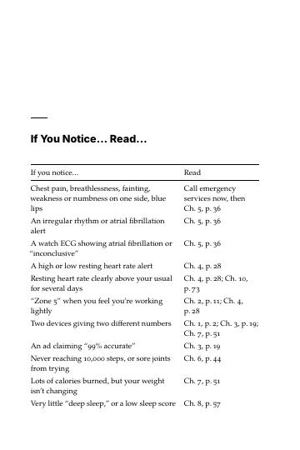
- Reference table If You Notice… Read… Get the PDF
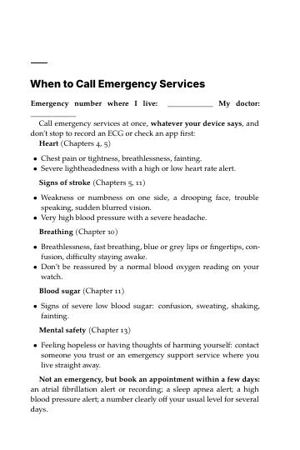
- Safety card When to Call Emergency Services Get the PDF
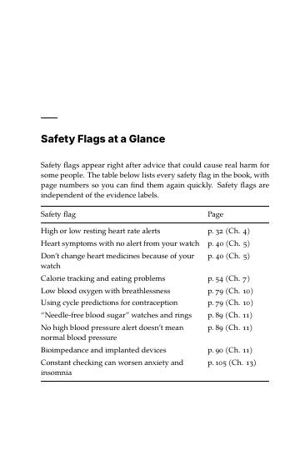
- Safety card Safety Flags at a Glance Get the PDF
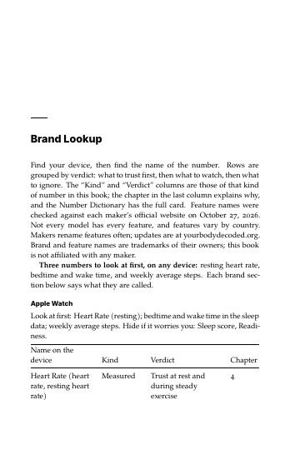
- Reference table Brand Lookup Get the PDF
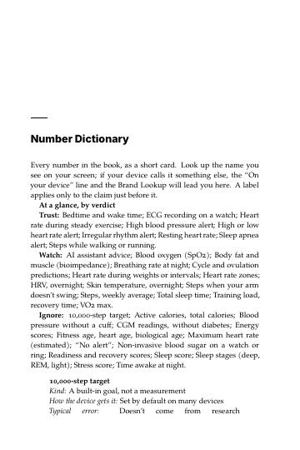
- Reference table Number Dictionary Get the PDF
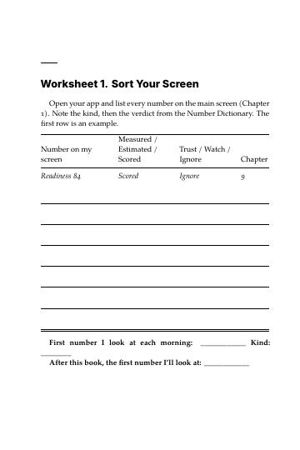
- Worksheet Worksheet 1. Sort Your Screen Get the PDF
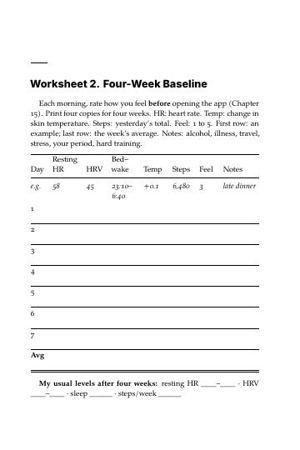
- Worksheet Worksheet 2. Four-Week Baseline Get the PDF
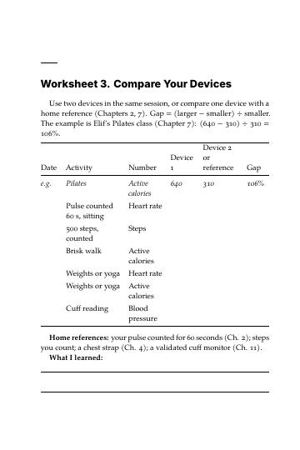
- Worksheet Worksheet 3. Compare Your Devices Get the PDF
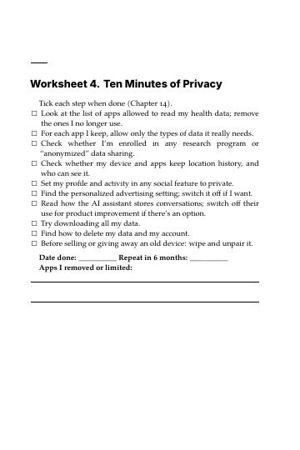
- Worksheet Worksheet 4. Ten Minutes of Privacy Get the PDF
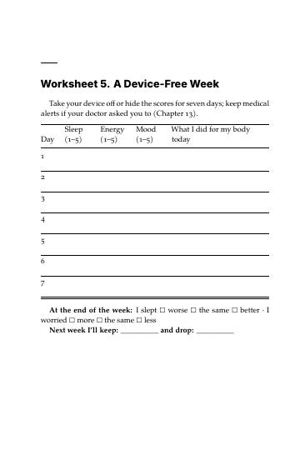
- Worksheet Worksheet 5. A Device-Free Week Get the PDF
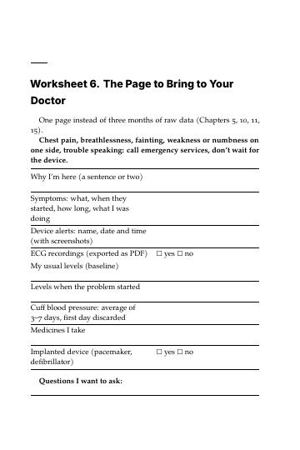
- Worksheet Worksheet 6. The Page to Bring to Your Doctor Get the PDF
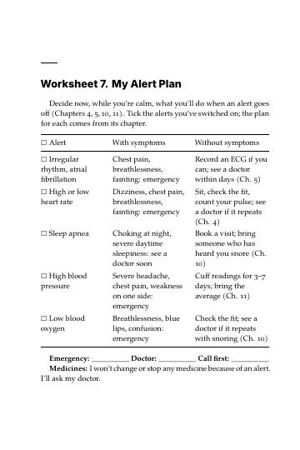
- Worksheet Worksheet 7. My Alert Plan Get the PDF
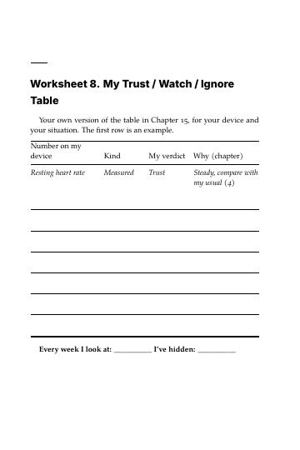
- Worksheet Worksheet 8. My Trust / Watch / Ignore Table Get the PDF
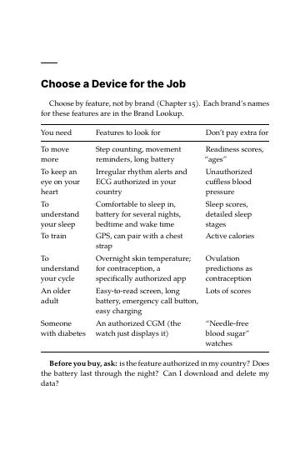
- Worksheet Choose a Device for the Job Get the PDF
79 references
Notes and sources
Ch. 1One Night, Two Numbers2
- Accuracy differs by kind of number Doherty C, Baldwin M, Keogh A, Caulfield B, Argent R. Keeping pace with wearables: a living umbrella review of systematic reviews evaluating the accuracy of consumer wearable technologies in health measurement. Sports Med 2024;54(11):2907–2926. doi:10.1007/s40279-024-02077-2. PMID 39080098.
- Composite scores use unpublished formulas Doherty C, Baldwin M, Lambe R, Burke D, Altini M. Readiness, recovery, and strain: an evaluation of composite health scores in consumer wearables. Transl Exerc Biomed 2025;2(2):128–144. doi:10.1515/teb-2025-0001.
Ch. 2Inside the Machine4
- Movement, skin tone and wrist heart rate Bent B, Goldstein BA, Kibbe WA, Dunn JP. Investigating sources of inaccuracy in wearable optical heart rate sensors. NPJ Digit Med 2020;3:18. doi:10.1038/s41746-020-0226-6. PMID 32047863.
- Error by sex, body size and skin tone Shcherbina A, Mattsson CM, Waggott D, et al. Accuracy in wrist-worn, sensor-based measurements of heart rate and energy expenditure in a diverse cohort. J Pers Med 2017;7(2):3. doi:10.3390/jpm7020003. PMID 28538708.
- Accuracy overview Doherty et al. 2024. See Chapter 1.
- How to wear a device Apple Support. Get the most accurate measurements using your Apple Watch (article 105002); Garmin. Tips for Erratic Heart Rate Data (fēnix 8 owner's manual); Oura Member Care. Ring sizing and finger guidance. All checked October 27, 2026.
Ch. 3Who Checks the Checker?9
- Algorithms change faster than studies; few devices validated Doherty et al. 2024. See Chapter 1.
- Authorized features and wellness features US Food and Drug Administration. General Wellness: Policy for Low Risk Devices. Final guidance, January 2026. Docket FDA-2014-N-1039.
- Wake detection in a validation study Chinoy ED, Cuellar JA, Huwa KE, et al. Performance of seven consumer sleep-tracking devices compared with polysomnography. Sleep 2021;44(5):zsaa291. doi:10.1093/sleep/zsaa291. PMID 33378539.
- A small validation study Dial MB, Hollander ME, Vatne EA, Emerson AM, Edwards NA, Hagen JA. Validation of nocturnal resting heart rate and heart rate variability in consumer wearables. Physiol Rep 2025;13(16):e70527. doi:10.14814/phy2.70527. PMID 40834291.
- Who funds the study Perez MV, Mahaffey KW, Hedlin H, et al. Large-scale assessment of a smartwatch to identify atrial fibrillation. N Engl J Med 2019;381(20):1909–1917. doi:10.1056/NEJMoa1901183. PMID 31722151. Miller DJ, Sargent C, Roach GD. A validation of six wearable devices for estimating sleep, heart rate and heart rate variability in healthy adults. Sensors (Basel) 2022;22(16):6317. doi:10.3390/s22166317. PMID 36016077. Maijala A, Kinnunen H, Koskimäki H, Jämsä T, Kangas M. Nocturnal finger skin temperature in menstrual cycle tracking: ambulatory pilot study using a wearable Oura ring. BMC Womens Health 2019;19(1):150. doi:10.1186/s12905-019-0844-9. PMID 31783840.
- A correction that changed a comparison Barrera N, Solorzano M, Jimenez Y, et al. Accuracy of smartwatches in the detection of atrial fibrillation: a systematic review and diagnostic meta-analysis. JACC Adv 2025;4(11 Pt 1):102133. doi:10.1016/j.jacadv.2025.102133. PMID 41182224. Correction: JACC Adv 2026;5(5):102728. PMID 42012426.
- VO2 max error Lambe R, O'Grady B, Baldwin M, Doherty C. Investigating the accuracy of Apple Watch VO2 max measurements: a validation study. PLoS One 2025;20(5):e0323741. doi:10.1371/journal.pone.0323741. PMID 40373042.
- Sensitivity and specificity of a hypertension alert US Food and Drug Administration. 510(k) summary K250507, Apple Hypertension Notification Feature, September 11, 2025.
- Kappa for sleep stages Schyvens AM, Peters B, Van Oost NC, et al. A performance validation of six commercial wrist-worn wearable sleep-tracking devices for sleep stage scoring compared to polysomnography. Sleep Adv 2025;6(2):zpaf021. doi:10.1093/sleepadvances/zpaf021. PMID 40303381.
Ch. 4Heart Rate5
- Resting and steady-exercise heart rate accuracy Doherty et al. 2024. See Chapter 1. Shcherbina et al. 2017. See Chapter 2.
- Weights, intervals and fast changes Bent et al. 2020. See Chapter 2.
- "220 minus age." Tanaka H, Monahan KD, Seals DR. Age-predicted maximal heart rate revisited. J Am Coll Cardiol 2001;37(1):153–156. doi:10.1016/s0735-1097(00)01054-801054-8). PMID 11153730.
- Resting heart rate and mortality Zhang D, Shen X, Qi X. Resting heart rate and all-cause and cardiovascular mortality in the general population: a meta-analysis. CMAJ 2016;188(3):E53–E63. doi:10.1503/cmaj.150535. PMID 26598376.
- Normal resting heart rate varies between people Quer G, Gouda P, Galarnyk M, Topol EJ, Steinhubl SR. Inter- and intraindividual variability in daily resting heart rate and its associations with age, sex, sleep, BMI, and time of year: retrospective, longitudinal cohort study of 92,457 adults. PLoS One 2020;15(2):e0227709. doi:10.1371/journal.pone.0227709. PMID 32023264.
Ch. 5When the Rhythm Is Off4
- The Apple Heart Study Perez et al. 2019. See Chapter 3.
- Pooled accuracy for atrial fibrillation Barrera et al. 2025, and correction 2026. See Chapter 3.
- Screening for atrial fibrillation US Preventive Services Task Force. Screening for Atrial Fibrillation. Final recommendation statement, January 25, 2022.
- What a watch ECG cannot detect Apple Support. Take an ECG with the ECG app on Apple Watch (article 120278). Checked October 27, 2026.
Ch. 6Steps and Movement5
- Step-count accuracy Doherty et al. 2024. See Chapter 1.
- Steps and mortality Paluch AE, Bajpai S, Bassett DR, et al. Daily steps and all-cause mortality: a meta-analysis of 15 international cohorts. Lancet Public Health 2022;7(3):e219–e228. doi:10.1016/S2468-2667(21)00302-900302-9). PMID 35247352.
- Where 10,000 came from Tudor-Locke C, Bassett DR Jr. How many steps/day are enough? Preliminary pedometer indices for public health. Sports Med 2004;34(1):1–8. doi:10.2165/00007256-200434010-00001. PMID 14715035.
- Steps in older women Lee IM, Shiroma EJ, Kamada M, et al. Association of step volume and intensity with all-cause mortality in older women. JAMA Intern Med 2019;179(8):1105–1112. doi:10.1001/jamainternmed.2019.0899. PMID 31141585.
- Trackers help people move more Ferguson T, Olds T, Curtis R, et al. Effectiveness of wearable activity trackers to increase physical activity and improve health: a systematic review of systematic reviews and meta-analyses. Lancet Digit Health 2022;4(8):e615–e626. doi:10.1016/S2589-7500(22)00111-X00111-X). PMID 35868813.
Ch. 7Calories Burned2
- The Stanford study Shcherbina et al. 2017. See Chapter 2. Median error range by device as reported in Healio's summary of the study.
- Average bias across reviews Doherty et al. 2024. See Chapter 1.
Ch. 8Sleep: Hours, Stages and Scores5
- Sleep and wake detection Chinoy et al. 2021. See Chapter 3. Schyvens et al. 2025. See Chapter 3. Doherty et al. 2024. See Chapter 1.
- Sleep stages Miller et al. 2022. See Chapter 3. Schyvens AM, Van Oost NC, Aerts JM, et al. Accuracy of Fitbit Charge 4, Garmin Vivosmart 4, and WHOOP versus polysomnography: systematic review. JMIR Mhealth Uhealth 2024;12:e52192. doi:10.2196/52192. PMID 38557808.
- Devices and insomnia Dong X, Yang S, Guo Y, et al. Validation of Fitbit Charge 4 for assessing sleep in Chinese patients with chronic insomnia: a comparison against polysomnography and actigraphy. PLoS One 2022;17(10):e0275287. doi:10.1371/journal.pone.0275287. PMID 36256631.
- Sleep regularity Sletten TL, Weaver MD, Foster RG, et al. The importance of sleep regularity: a consensus statement of the National Sleep Foundation sleep timing and variability panel. Sleep Health 2023;9(6):801–820. doi:10.1016/j.sleh.2023.07.016. PMID 37684151. Windred DP, Burns AC, Lane JM, et al. Sleep regularity is a stronger predictor of mortality risk than sleep duration: a prospective cohort study. Sleep 2024;47(1):zsad253. doi:10.1093/sleep/zsad253. PMID 37738616.
- Sleep scores as composite scores Doherty et al. 2025. See Chapter 1.
Ch. 9HRV, Readiness, Recovery and Stress5
- Composite scores Doherty et al. 2025. See Chapter 1.
- Overnight HRV accuracy Dial et al. 2025. See Chapter 3.
- HRV and cardiovascular events Hillebrand S, Gast KB, de Mutsert R, et al. Heart rate variability and first cardiovascular event in populations without known cardiovascular disease: meta-analysis and dose-response meta-regression. Europace 2013;15(5):742–749. doi:10.1093/europace/eus341. PMID 23370966.
- Raising device HRV PubMed search, October 27, 2026: no trials found linking efforts to raise wearable HRV with health outcomes.
- Slow-breathing training with heart rate feedback Lehrer P, Kaur K, Sharma A, et al. Heart rate variability biofeedback improves emotional and physical health and performance: a systematic review and meta analysis. Appl Psychophysiol Biofeedback 2020;45(3):109–129. doi:10.1007/s10484-020-09466-z. PMID 32385728.
Ch. 10Night Signals: Oxygen, Breathing, Temperature and Cycles7
- Skin tone and pulse oximetry Sjoding MW, Dickson RP, Iwashyna TJ, Gay SE, Valley TS. Racial bias in pulse oximetry measurement. N Engl J Med 2020;383(25):2477–2478. doi:10.1056/NEJMc2029240. PMID 33326721. Valbuena VSM, Seelye S, Sjoding MW, et al. Racial bias and reproducibility in pulse oximetry among medical and surgical inpatients in general care in the Veterans Health Administration 2013–19: multicenter, retrospective cohort study. BMJ 2022;378:e069775. doi:10.1136/bmj-2021-069775. PMID 35793817. US Food and Drug Administration. Pulse Oximeters for Medical Purposes: Non-Clinical and Clinical Performance Testing, Labeling, and Premarket Submission Recommendations. Draft guidance, January 2025.
- Wearable blood oxygen error Doherty et al. 2024. See Chapter 1.
- Limits of oximeters US Food and Drug Administration. Safety communication on pulse oximeter accuracy and limitations, February 2021.
- Sleep apnea alerts Apple. Sleep Apnea Notifications on Apple Watch, September 2024; US Food and Drug Administration 510(k) K240929.
- Skin temperature and the menstrual cycle Maijala et al. 2019. See Chapter 3.
- Contraception apps US Food and Drug Administration. News release on the first direct-to-consumer app for contraception, August 2018; 510(k) K202897 (2021).
- Early signs of infection Mishra T, Wang M, Metwally AA, et al. Pre-symptomatic detection of COVID-19 from smartwatch data. Nat Biomed Eng 2020;4(12):1208–1220. doi:10.1038/s41551-020-00640-6. PMID 33208926.
Ch. 11Blood Pressure, Blood Sugar and Body Composition6
- Non-invasive blood sugar US Food and Drug Administration. Do Not Use Smartwatches or Smart Rings to Measure Blood Glucose Levels. Safety communication, February 21, 2024.
- Cuffless blood pressure US Food and Drug Administration. Do Not Use Unauthorized Devices for Measuring Blood Pressure. Safety communication, September 16, 2025. FDA General Wellness guidance, January 2026. See Chapter 3.
- Hypertension alert accuracy FDA 510(k) K250507. See Chapter 3. Houston Methodist commentary on the hypertension notification, May 2026.
- Measuring blood pressure at home Parati G, Stergiou GS, Bilo G, et al. Home blood pressure monitoring: methodology, clinical relevance and practical application: a 2021 position paper by the Working Group on Blood Pressure Monitoring and Cardiovascular Variability of the European Society of Hypertension. J Hypertens 2021;39(9):1742–1767. doi:10.1097/HJH.0000000000002922. PMID 34269334. Validated monitor list: validatebp.org (American Medical Association).
- Watch body composition Carrier B, Melvin AC, Outwin JR, et al. Wearables for health monitoring: body composition estimates of commercial smartwatch and clinical bioelectrical impedance device. Front Sports Act Living 2025;7:1644082. doi:10.3389/fspor.2025.1644082. PMID 41341278. Bennett JP, Liu YE, Kelly NN, et al. Next-generation smart watches to estimate whole-body composition using bioimpedance analysis: accuracy and precision in a diverse, multiethnic sample. Am J Clin Nutr 2022;116(5):1418–1429. doi:10.1093/ajcn/nqac200. PMID 35883219.
- Bioimpedance and implanted devices Ha GB, Steinberg BA, Freedman R, Bayés-Genís A, Sanchez B. Safety evaluation of smart scales, smart watches, and smart rings with bioimpedance technology shows evidence of potential interference in cardiac implantable electronic devices. Heart Rhythm 2023;20(4):561–571. doi:10.1016/j.hrthm.2022.11.026. PMID 36997272. Hansen N, Sheppard T, McCoy J, et al. Smartwatches and smart scales with body composition may interfere with cardiac implantable electronic devices. Circ Arrhythm Electrophysiol 2025;18(12):e013881. doi:10.1161/CIRCEP.125.013881. PMID 41328543. Uribe-Cavero LJ, Chavez-Ecos FA, Camacho-Caballero K, et al. Safety of bioelectrical impedance analysis in patients with cardiac implantable electronic devices: a systematic review. Heart Rhythm O2 2025;6(12):1985–1992. doi:10.1016/j.hroo.2025.09.026. PMID 41541720. Samsung Support. Body composition measurement guidance. Checked October 27, 2026.
Ch. 12Fitness, Age Scores and CGMs5
- Fitness and mortality Kodama S, Saito K, Tanaka S, et al. Cardiorespiratory fitness as a quantitative predictor of all-cause mortality and cardiovascular events in healthy men and women: a meta-analysis. JAMA 2009;301(19):2024–2035. doi:10.1001/jama.2009.681. PMID 19454641.
- Wearable VO2 max Doherty et al. 2024. See Chapter 1. Lambe et al. 2025. See Chapter 3.
- "Age" scores PubMed search, October 27, 2026: no independent validation of any brand's "age" score found.
- Training load and recovery scores Doherty et al. 2025. See Chapter 1.
- CGMs in healthy people Shah VN, DuBose SN, Li Z, et al. Continuous glucose monitoring profiles in healthy nondiabetic participants: a multicenter prospective study. J Clin Endocrinol Metab 2019;104(10):4356–4364. doi:10.1210/jc.2018-02763. PMID 31127824. Healio. Report of an expert presentation on CGM use in people without diabetes, January 20, 2026.
Ch. 13Data Anxiety7
- Orthosomnia Baron KG, Abbott S, Jao N, Manalo N, Mullen R. Orthosomnia: are some patients taking the quantified self too far? J Clin Sleep Med 2017;13(2):351–354. doi:10.5664/jcsm.6472. PMID 27855740.
- How common it is Jahrami H, Trabelsi K, Husain W, et al. Prevalence of orthosomnia in a general population sample: a cross-sectional study. Brain Sci 2024;14(11):1123. doi:10.3390/brainsci14111123. PMID 39595886.
- Sleep wearables in Canada Dion K, Porteous M, Kendzerska T, et al. Sleep, health care-seeking behaviors, and perceptions associated with the use of sleep wearables in Canada: results from a nationally representative survey. J Med Internet Res 2025;27:e68816. doi:10.2196/68816. PMID 40534180.
- Heart alerts and anxiety Rosman L, Lampert R, Zhuo S, et al. Wearable devices, health care use, and psychological well-being in patients with atrial fibrillation. J Am Heart Assoc 2024;13(15):e033750. doi:10.1161/JAHA.123.033750. PMID 39011944. Varma N, Han JK, Passman R, et al. Promises and perils of consumer mobile technologies in cardiovascular care: JACC Scientific Statement. J Am Coll Cardiol 2024;83(5):611–631. doi:10.1016/j.jacc.2023.11.024. PMID 38296406.
- Treating insomnia Edinger JD, Arnedt JT, Bertisch SM, et al. Behavioral and psychological treatments for chronic insomnia disorder in adults: an American Academy of Sleep Medicine clinical practice guideline. J Clin Sleep Med 2021;17(2):255–262. doi:10.5664/jcsm.8986. PMID 33164742.
- Treating health anxiety Lai L, Liu Y, Axelsson E, et al. The comparative effectiveness of psychological interventions for health anxiety: systematic review and a network meta-analysis of randomised controlled trials. Br J Psychiatry 2026:1–10 (published online May 22, 2026). doi:10.1192/bjp.2026.10647. PMID 42169209.
- Slow breathing Lehrer et al. 2020. See Chapter 9.
Ch. 14Who Else Reads Your Numbers?7
- Data sharing by health apps Grundy Q, Chiu K, Held F, et al. Data sharing practices of medicines related apps and the mobile ecosystem: traffic, content, and network analysis. BMJ 2019;364:l920. doi:10.1136/bmj.l920. PMID 30894349.
- HIPAA and consumer devices US Department of Health and Human Services, Office of the National Coordinator for Health IT. Examining Oversight of the Privacy & Security of Health Data Collected by Entities Not Regulated by HIPAA. Report to Congress, July 2016.
- Breach notification US Federal Trade Commission. Health Breach Notification Rule; final rule. Federal Register 2024;89:47028 (May 30, 2024); effective July 29, 2024.
- EU law Regulation (EU) 2016/679 (General Data Protection Regulation), Articles 4(15) and 9. European Data Protection Board and European Data Protection Supervisor. Joint Opinion 03/2022 on the Proposal for a Regulation on the European Health Data Space. July 12, 2022.
- The Flo case Fierce Healthcare. Report on the California jury verdict concerning Flo Health data, August 4, 2025, including the 2021 FTC settlement.
- AI coaches Khasentino J, Belyaeva A, Liu X, et al. A personal health large language model for sleep and fitness coaching. Nat Med 2025;31(10):3394–3403. doi:10.1038/s41591-025-03888-0. PMID 40813712.
- Wellness devices FDA General Wellness guidance, January 2026. See Chapter 3.
Ch. 15Read Your Device Like a Scientist4
- Trackers help people move more Ferguson et al. 2022. See Chapter 6.
- Compare with yourself Quer et al. 2020. See Chapter 4.
- Accuracy by kind of number Doherty et al. 2024. See Chapter 1.
- Home blood pressure Parati et al. 2021. See Chapter 11.
BackWorksheets at the back of the book2
- Brand Lookup Feature names checked on October 27, 2026 against official pages of Apple (Apple Health features page), Samsung (Samsung Health page and Samsung Newsroom, 2026), Google (Google Health Help, "What is Morning Brief"), Garmin (Garmin blog pages on health and sleep features), Oura (Oura Member Care help categories) and WHOOP (WHOOP membership page).
- Worksheets 1–6 and Choose a Device for the Job Based on the chapters named on each page; the four-week baseline and the device-free week are this book's practical methods, not tested in studies of their own.
Updates and corrections
Evidence last reviewed October 27, 2026
Each evidence label shows how solid the evidence was on the day it was last reviewed. Corrections are posted here with the date they were made, and included in the next printing.
No corrections have been posted for this edition. Spotted an error, or a study that should change a label? Email hello@yourbodydecoded.org
Most likely to change
- Makers’ feature names and new features (the Brand Lookup)
- FDA policy on wellness devices and which features are authorized (Chapters 3, 11)
- Cuffless blood pressure and non-invasive blood sugar (Chapter 11)
- Research on atrial fibrillation alerts and screening (Chapter 5)
- Validation studies of sleep, HRV and composite scores (Chapters 8, 9)
- Privacy laws and AI health assistants (Chapter 14)
Get an email when it's out
One email on publication day. Nothing else unless you ask.