BooksVol. 17Coming soon
Why Do I Always Quit by February?
How to Keep Your New Year's Resolutions and Build Healthy Habits That Last: An Evidence-Based Guide Without Willpower Myths
by An Thanh Tùng
About this book
You don't quit because you lack willpower. Your plan was written by your January 1 self for someone who doesn't exist.Chapter 1
A plain-language, evidence-labeled guide for anyone who makes New Year's resolutions and drops them by February. It doesn't blame willpower. Your plan was written by your January 1 self for a February 15 self who sleeps less, is more stressed and more sore, and this book shows how to write it for the person who has to carry it out: why willpower myths and the 21-day rule mislead, what really happens with exercise, diets, "quit" goals and sleep, and how to build a one-page Handover Note, change your surroundings, recover from a missed day and start again on the next fresh start.
What you'll learn
- Ch. 2A contract signed by the wrong personRead your plan through the eyes of your February 15 self, and add clauses for the bad day.
- Ch. 3Disciplined people resist less, not betterThey arrange things so they have to resist less. You can do that too.
- Ch. 4The 21-day rule is a mythNew habits usually take about two months. If weeks 3 to 6 feel hard, you're on the uphill stretch, not failing.
- Ch. 8Keep the cue, change the actionDon't try to erase a habit by not thinking about it. Give the cue a new action that meets the same need.
- Ch. 11Change the field, not the playerMake the good habit a few seconds easier and the old one a few seconds harder.
- Ch. 13Every year has many New Year's DaysA second fresh start is stronger than the first, because you now have the log from the last trip.
How the book is organized
- Part IWhere Plans Lose Their Way
- Part IIThe Familiar Detours
- Part IIIRedrawing the Map for Your February Self
Look inside
Pages from the book
From the review draft.
- How to read this book
- Chapter 1 opens
- Try it at home
- If you remember one thing
- A printable worksheet
- Notes and sources
Free with your email
Worksheets from this book
From the review draft. Final versions are posted on publication day.
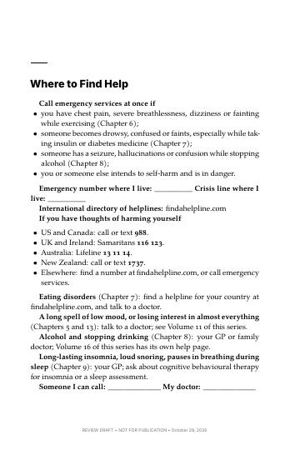
- Safety card Where to Find Help Get the PDF
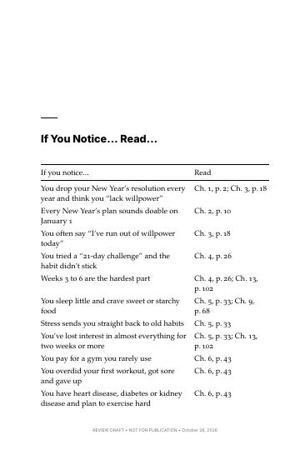
- Reference table If You Notice… Read… Get the PDF
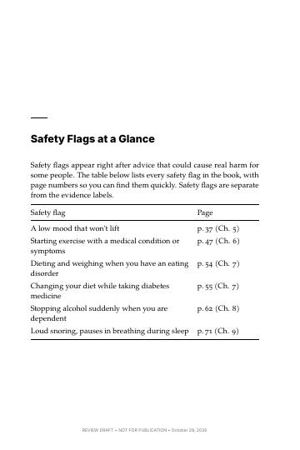
- Safety card Safety Flags at a Glance Get the PDF
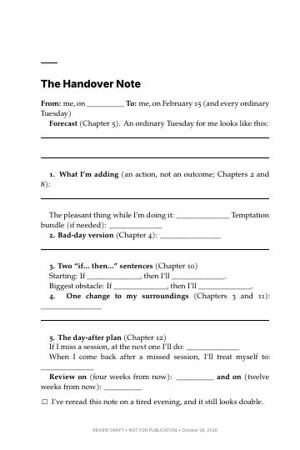
- Worksheet The Handover Note Get the PDF
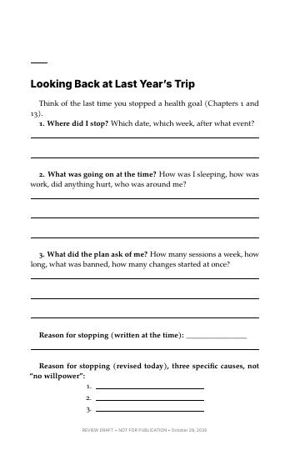
- Worksheet Looking Back at Last Year’s Trip Get the PDF
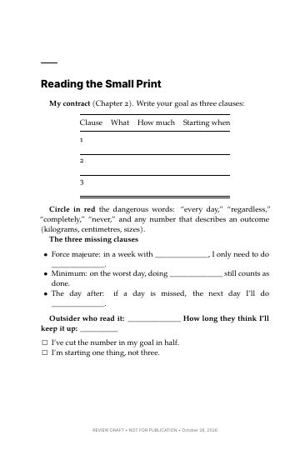
- Worksheet Reading the Small Print Get the PDF
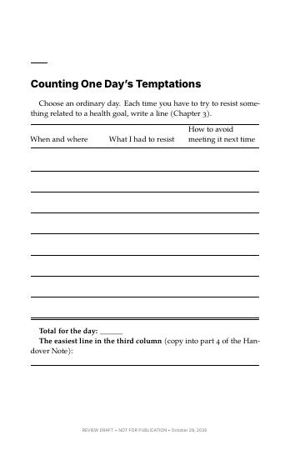
- Worksheet Counting One Day’s Temptations Get the PDF
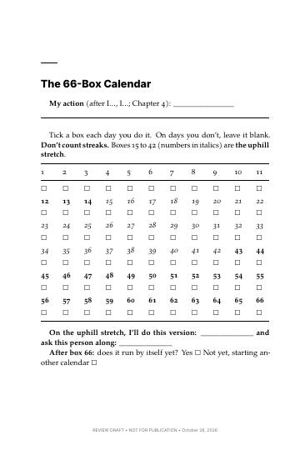
- Worksheet The 66-Box Calendar Get the PDF
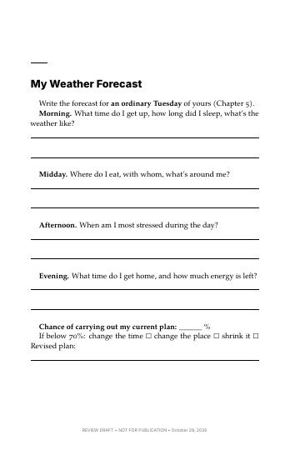
- Worksheet My Weather Forecast Get the PDF
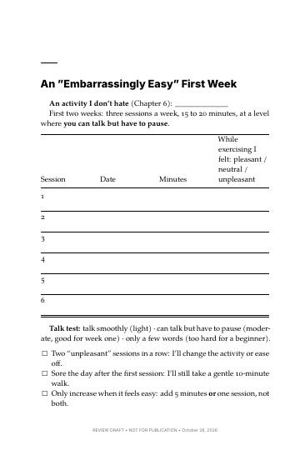
- Worksheet An ”Embarrassingly Easy” First Week Get the PDF
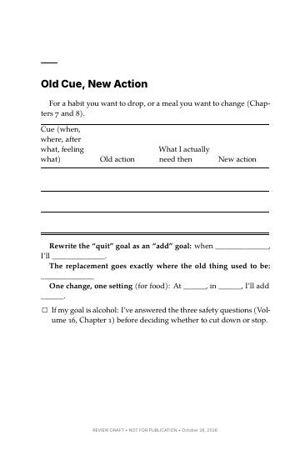
- Worksheet Old Cue, New Action Get the PDF
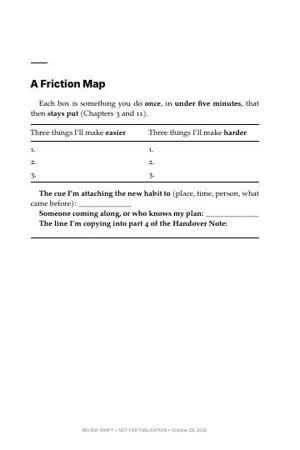
- Worksheet A Friction Map Get the PDF
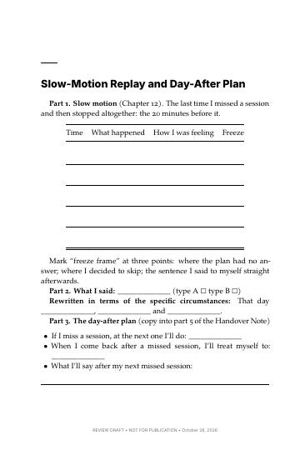
- Worksheet Slow-Motion Replay and Day-After Plan Get the PDF
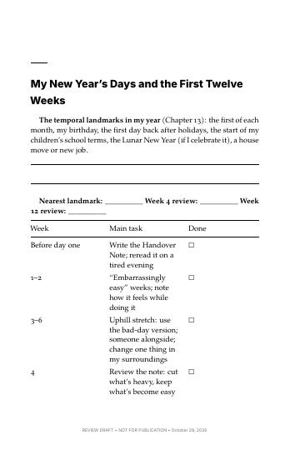
- Worksheet My New Year’s Days and the First Twelve Weeks Get the PDF
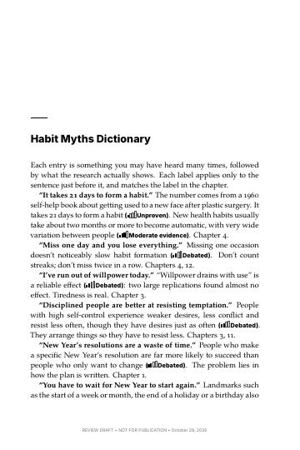
- Reference table Habit Myths Dictionary Get the PDF
69 references
Notes and sources
Ch. 1Why Do I Always Quit by February?5
- How many people make resolutions, and which ones YouGov. Americans' New Year's resolutions for 2026. Survey of 1,104 US adults, December 9–11, 2025.
- "Quitter's Day." Strava. Annual analysis of logged activities in January, 2019 and 2020 releases.
- Resolvers and non-resolvers after six months Norcross JC, Mrykalo MS, Blagys MD. Auld lang syne: success predictors, change processes, and self-reported outcomes of New Year's resolvers and nonresolvers. J Clin Psychol 2002;58(4):397–405.
- Slips among successful resolvers over two years Norcross JC, Vangarelli DJ. The resolution solution: longitudinal examination of New Year's change attempts. J Subst Abuse 1988;1(2):127–134.
- A large trial of New Year's resolutions Oscarsson M, Carlbring P, Andersson G, Rozental A. A large-scale experiment on New Year's resolutions: approach-oriented goals are more successful than avoidance-oriented goals. PLoS One 2020;15(12):e0234097. doi:10.1371/journal.pone.0234097.
Ch. 2The Contract You Signed on January 14
- The hot-cold empathy gap Loewenstein G. Hot-cold empathy gaps and medical decision making. Health Psychol 2005;24(4 Suppl):S49–S56.
- The planning fallacy Buehler R, Griffin D, Ross M. Exploring the "planning fallacy": why people underestimate their task completion times. J Pers Soc Psychol 1994;67(3):366–381.
- False hope syndrome Polivy J, Herman CP. The false-hope syndrome: unfulfilled expectations of self-change. Curr Dir Psychol Sci 2000;9(4):128–131. doi:10.1111/1467-8721.00076.
- The fresh start effect Dai H, Milkman KL, Riis J. The fresh start effect: temporal landmarks motivate aspirational behavior. Manage Sci 2014;60(10):2563–2582. doi:10.1287/mnsc.2014.1901.
Ch. 3Willpower Isn't a Fuel Tank5
- The original radish-and-cookie study Baumeister RF, Bratslavsky E, Muraven M, Tice DM. Ego depletion: is the active self a limited resource? J Pers Soc Psychol 1998;74(5):1252–1265.
- The first multi-lab replication Hagger MS, Chatzisarantis NLD, Alberts H, et al. A multilab preregistered replication of the ego-depletion effect. Perspect Psychol Sci 2016;11(4):546–573. doi:10.1177/1745691616652873.
- The second multi-site test Vohs KD, Schmeichel BJ, Lohmann S, et al. A multisite preregistered paradigmatic test of the ego-depletion effect. Psychol Sci 2021;32(10):1566–1581. doi:10.1177/0956797621989733.
- Everyday temptations and self-control Hofmann W, Baumeister RF, Förster G, Vohs KD. Everyday temptations: an experience sampling study of desire, conflict, and self-control. J Pers Soc Psychol 2012;102(6):1318–1335. doi:10.1037/a0026545.
- Habits and self-control Galla BM, Duckworth AL. More than resisting temptation: beneficial habits mediate the relationship between self-control and positive life outcomes. J Pers Soc Psychol 2015;109(3):508–525.
Ch. 4Twenty-One Days, or Two Hundred?4
- Where 21 days came from Maltz M. Psycho-Cybernetics. 1960. Traced by the Health Behaviour Research Centre, University College London, 2012.
- How long habits take to form Singh B, Murphy A, Maher C, Smith AE. Time to form a habit: a systematic review and meta-analysis of health behaviour habit formation and its determinants. Healthcare (Basel) 2024;12(23):2488. doi:10.3390/healthcare12232488.
- Modelling habit formation in everyday life Lally P, van Jaarsveld CHM, Potts HWW, Wardle J. How are habits formed: modelling habit formation in the real world. Eur J Soc Psychol 2010;40(6):998–1009.
- Exercise habits in new gym members Kaushal N, Rhodes RE. Exercise habit formation in new gym members: a longitudinal study. J Behav Med 2015;38(4):652–663. doi:10.1007/s10865-015-9640-7.
Ch. 5Your Body on February 154
- Short sleep, hunger hormones and appetite Spiegel K, Tasali E, Penev P, Van Cauter E. Brief communication: sleep curtailment in healthy young men is associated with decreased leptin levels, elevated ghrelin levels, and increased hunger and appetite. Ann Intern Med 2004;141(11):846–850.
- Partial sleep loss and energy intake Al Khatib HK, Harding SV, Darzi J, Pot GK. The effects of partial sleep deprivation on energy balance: a systematic review and meta-analysis. Eur J Clin Nutr 2017;71(5):614–624. doi:10.1038/ejcn.2016.201.
- Sleeping more and free sugars Al Khatib HK, Hall WL, Creedon A, et al. Sleep extension is a feasible lifestyle intervention in free-living adults who are habitually short sleepers: a potential strategy for decreasing intake of free sugars? A randomized controlled pilot study. Am J Clin Nutr 2018;107(1):43–53. doi:10.1093/ajcn/nqx030.
- Stress and habits Schwabe L, Wolf OT. Stress prompts habit behavior in humans. J Neurosci 2009;29(22):7191–7198. doi:10.1523/JNEUROSCI.0979-09.2009.
Ch. 6The Gym Card and the Too-Hard First Week5
- Gym memberships and attendance DellaVigna S, Malmendier U. Paying not to go to the gym. Am Econ Rev 2006;96(3):694–719.
- Exercise intensity and pleasure Ekkekakis P, Parfitt G, Petruzzello SJ. The pleasure and displeasure people feel when they exercise at different intensities: decennial update and progress towards a tripartite rationale for exercise intensity prescription. Sports Med 2011;41(8):641–671.
- How exercise feels and future activity Rhodes RE, Kates A. Can the affective response to exercise predict future motives and physical activity behavior? A systematic review of published evidence. Ann Behav Med 2015;49(5):715–731. doi:10.1007/s12160-015-9704-5.
- The 10% rule Buist I, Bredeweg SW, van Mechelen W, Lemmink KAPM, Pepping GJ, Diercks RL. No effect of a graded training program on the number of running-related injuries in novice runners: a randomized controlled trial. Am J Sports Med 2008;36(1):33–39. doi:10.1177/0363546507307505.
- Screening before exercise Riebe D, Franklin BA, Thompson PD, et al. Updating ACSM's recommendations for exercise preparticipation health screening. Med Sci Sports Exerc 2015;47(11):2473–2479. doi:10.1249/MSS.0000000000000664.
Ch. 7"Clean Eating Starts Monday"5
- Named diets compared Johnston BC, Kanters S, Bandayrel K, et al. Comparison of weight loss among named diet programs in overweight and obese adults: a meta-analysis. JAMA 2014;312(9):923–933. doi:10.1001/jama.2014.10397.
- Four diets and adherence Dansinger ML, Gleason JA, Griffith JL, Selker HP, Schaefer EJ. Comparison of the Atkins, Ornish, Weight Watchers, and Zone diets for weight loss and heart disease risk reduction: a randomized trial. JAMA 2005;293(1):43–53.
- Self-weighing Madigan CM, Daley AJ, Lewis AL, Aveyard P, Jolly K. Is self-weighing an effective tool for weight loss: a systematic literature review and meta-analysis. Int J Behav Nutr Phys Act 2015;12:104. doi:10.1186/s12966-015-0267-4.
- Dieting and rebound eating Polivy J, Herman CP. Dieting and binging: a causal analysis. Am Psychol 1985;40(2):193–201.
- Flexible and rigid control Westenhoefer J, Stunkard AJ, Pudel V. Validation of the flexible and rigid control dimensions of dietary restraint. Int J Eat Disord 1999;26(1):53–64.
Ch. 8The "Quit" Goals: Alcohol, Sugar, Your Phone7
- Approach and avoidance goals Oscarsson et al. 2020. See Chapter 1.
- The white bear Wegner DM, Schneider DJ, Carter SR, White TL. Paradoxical effects of thought suppression. J Pers Soc Psychol 1987;53(1):5–13.
- Suppressing thoughts of chocolate Erskine JAK. Resistance can be futile: investigating behavioural rebound. Appetite 2008;50(2–3):415–421. doi:10.1016/j.appet.2007.09.006.
- The psychology of habit Wood W, Rünger D. Psychology of habit. Annu Rev Psychol 2016;67:289–314.
- Dopamine fasting Grinspoon P. Dopamine fasting: misunderstanding science spawns a maladaptive fad. Harvard Health Blog, Harvard Health Publishing, February 26, 2020.
- Limiting social media Hunt MG, Marx R, Lipson C, Young J. No more FOMO: limiting social media decreases loneliness and depression. J Soc Clin Psychol 2018;37(10):751–768. doi:10.1521/jscp.2018.37.10.751.
- Stopping alcohol safely American Society of Addiction Medicine. The ASAM clinical practice guideline on alcohol withdrawal management. J Addict Med 2020;14(3S Suppl 1):1–72. doi:10.1097/ADM.0000000000000668.
Ch. 9Sleep: The Goal Under Every Other Goal3
- Bedtime procrastination Kroese FM, de Ridder DTD, Evers C, Adriaanse MA. Bedtime procrastination: introducing a new area of procrastination. Front Psychol 2014;5:611. doi:10.3389/fpsyg.2014.00611.
- Treating chronic insomnia Edinger JD, Arnedt JT, Bertisch SM, et al. Behavioral and psychological treatments for chronic insomnia disorder in adults: an American Academy of Sleep Medicine clinical practice guideline. J Clin Sleep Med 2021;17(2):255–262. doi:10.5664/jcsm.8986.
- Sleeping more and free sugars Al Khatib et al. 2018. See Chapter 5.
Ch. 10The Handover Note6
- "If… then…" plans Gollwitzer PM, Sheeran P. Implementation intentions and goal achievement: a meta-analysis of effects and processes. Adv Exp Soc Psychol 2006;38:69–119.
- Thinking about obstacles (WOOP) Wang G, Wang Y, Gai X. A meta-analysis of the effects of mental contrasting with implementation intentions on goal attainment. Front Psychol 2021;12:565202. doi:10.3389/fpsyg.2021.565202.
- Immediate rewards and long-term goals Woolley K, Fishbach A. Immediate rewards predict adherence to long-term goals. Pers Soc Psychol Bull 2017;43(2):151–162.
- Enjoyment and New Year's resolutions over a year Woolley K, Giurge LM, Fishbach A. Adherence to personal resolutions across time, culture, and goal domains. Psychol Sci 2025;36(8). doi:10.1177/09567976251350960.
- Temptation bundling, the first trial Milkman KL, Minson JA, Volpp KGM. Holding the Hunger Games hostage at the gym: an evaluation of temptation bundling. Manage Sci 2014;60(2):283–299. doi:10.1287/mnsc.2013.1784.
- Temptation bundling, the larger trial Kirgios EL, Mandel GH, Park Y, et al. Teaching temptation bundling to boost exercise: a field experiment. Organ Behav Hum Decis Process 2020;161(Suppl):20–35. doi:10.1016/j.obhdp.2020.09.003.
Ch. 11Change the Field, Not the Player4
- Habits in everyday life Wood W, Quinn JM, Kashy DA. Habits in everyday life: thought, emotion, and action. J Pers Soc Psychol 2002;83(6):1281–1297.
- Moving house and changing habits Verplanken B, Roy D. Empowering interventions to promote sustainable lifestyles: testing the habit discontinuity hypothesis in a field experiment. J Environ Psychol 2016;45:127–134. doi:10.1016/j.jenvp.2015.11.008.
- The gym megastudy Milkman KL, Gromet D, Ho H, et al. Megastudies improve the impact of applied behavioural science. Nature 2021;600(7889):478–483. doi:10.1038/s41586-021-04128-4.
- Deposit contracts Giné X, Karlan D, Zinman J. Put your money where your butt is: a commitment contract for smoking cessation. Am Econ J Appl Econ 2010;2(4):213–235. doi:10.1257/app.2.4.213.
Ch. 12A Slip in Slow Motion4
- The abstinence violation effect Marlatt GA, Gordon JR. Relapse Prevention: Maintenance Strategies in the Treatment of Addictive Behaviors. New York: Guilford Press; 1985. Curry S, Marlatt GA, Gordon JR. Abstinence violation effect: validation of an attributional construct with smoking cessation. J Consult Clin Psychol 1987;55(2):145–149.
- Self-compassion after breaking an eating rule Adams CE, Leary MR. Promoting self-compassionate attitudes toward eating among restrictive and guilty eaters. J Soc Clin Psychol 2007;26(10):1120–1144. doi:10.1521/jscp.2007.26.10.1120.
- Self-compassion and self-improvement Breines JG, Chen S. Self-compassion increases self-improvement motivation. Pers Soc Psychol Bull 2012;38(9):1133–1143.
- Rewarding the return after a missed workout Milkman et al. 2021. See Chapter 11.
Ch. 13The Second New Year3
- Temporal landmarks across the year Dai, Milkman and Riis 2014. See Chapter 2.
- "Quitter's Day." Strava 2019 and 2020. See Chapter 1.
- How long habits take Singh et al. 2024. See Chapter 4.
BackWorksheets at the back of the book10
- Where to find help See Chapters 5, 6, 7, 8 and 9 (Riebe et al. 2015; ASAM 2020; Edinger et al. 2021).
- The Handover Note See Chapters 1, 2, 4, 5, 10, 11 and 12 (Gollwitzer and Sheeran 2006; Woolley and Fishbach 2017; Milkman et al. 2021).
- Looking back at last year's trip and reading the small print See Chapters 1 and 2 (Norcross and Vangarelli 1988; Buehler et al. 1994).
- Counting temptations and the friction map See Chapters 3 and 11 (Hofmann et al. 2012; Wood et al. 2002).
- The 66-box calendar See Chapter 4 (Lally et al. 2010; Singh et al. 2024).
- My weather forecast See Chapter 5 (Al Khatib et al. 2017, 2018; Schwabe and Wolf 2009).
- An "embarrassingly easy" first week See Chapter 6 (Ekkekakis et al. 2011; Rhodes and Kates 2015; Riebe et al. 2015).
- Old cue, new action See Chapters 7 and 8 (Wegner et al. 1987; Wood and Rünger 2016).
- Slow-motion replay and day-after plan See Chapter 12 (Marlatt and Gordon 1985; Adams and Leary 2007).
- My New Year's Days and the first twelve weeks See Chapters 9 and 13 (Dai et al. 2014; Edinger et al. 2021).
Updates and corrections
Evidence last reviewed October 28, 2026
Each evidence label shows how solid the evidence was on the day it was last reviewed. Corrections are posted here with the date they were made, and included in the next printing.
No corrections have been posted for this edition. Spotted an error, or a study that should change a label? Email hello@yourbodydecoded.org
Get an email when it's out
One email on publication day. Nothing else unless you ask.